AI
AI moves fast, customers still call: notes from eight sectors
I work with AI every day, and even I find the pace dizzying. So last month I looked at how it all seems from inside a car workshop or a tax office.
In this post
I work with AI every day, and even I find the pace dizzying. So last month I asked how it all looks from inside a car workshop, a tax office or a roofer’s van. This article covers what I looked at, which numbers I used and why, and the one I left out.
The professionals are not the slow side
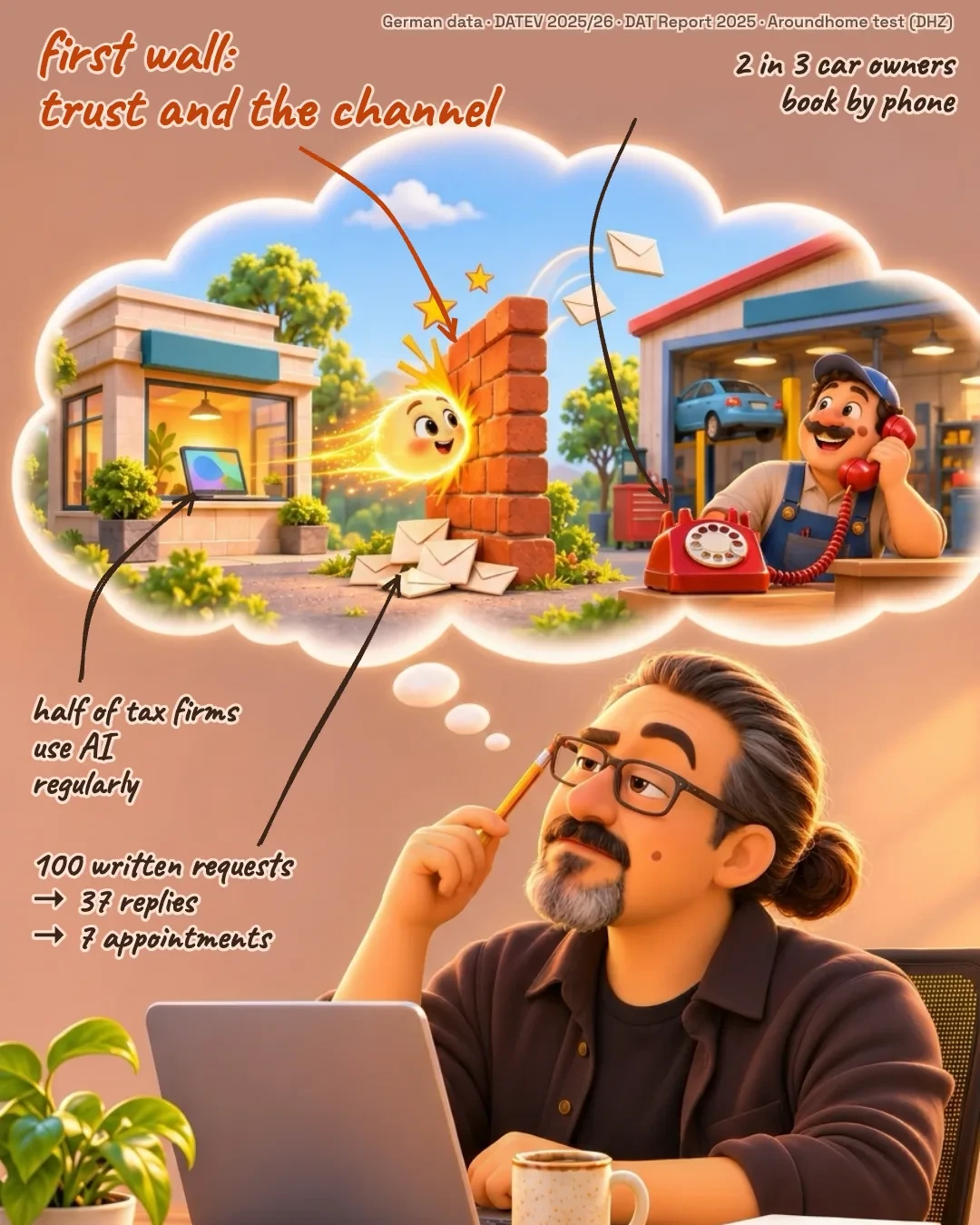
In DATEV’s digitalisation survey, half of German tax firms use AI regularly in 2026, up from about a third in 2025. For a profession built on paper and rules, that is a lot of ground in one year.
The same survey asked in 2025 what holds back their digitalisation. The most common answer was their clients: 59% named client acceptance, 54% lack of time and 46% the effort of putting it into practice. A firm being ready is not enough; the people who bring the documents, ask the questions and book the appointments have to come along.
Their customers still pick up the phone
According to the DAT Report 2025 (2024 data), about two in three car owners in Germany book a workshop appointment by phone: 66% at brand workshops, 63% at independent ones. For a workshop that cannot answer, that customer often just calls the next one.
Written requests can look like the way out. One measurement shows they do not work on their own either. The platform Aroundhome sent 100 identical written requests to each of five trades in Germany’s ten largest cities; Deutsche Handwerks Zeitung published the result:
| Trade | Requests that got a reply | Concrete appointment in the first reply |
|---|---|---|
| Roofers | 37 | 7 |
| Heating installers | 57 | 16 |
| Solar installers | 56 | not in my notes |
| Drywall installers | 54 | not in my notes |
| Window fitters | 76 | not in my notes |
For roofers, 37 of 100 requests got a reply and only 7 got an appointment. The test has clear limits: written requests, big cities, sent through a platform; it does not measure who answers the phone. Still, it shows that switching the channel is not a fix on its own. A roofer on a ladder cannot keep up with email any more than with the phone.
Why I left out the most quoted number
The grading paid off most on one figure. It is often said that German tradespeople miss 40% of their calls. I could not find a primary source for it; it lives on the blogs of companies selling AI phone answering. So I did not use it. It may be true, but before I say it to a business owner I want to see that someone measured it.
I saw the same with tax firms: figures on how many callers hang up when nobody answers are going around, but I found no independent study that measured it.
The first wall: trust and the channel
As I see it, the first wall in front of AI in small businesses is not awareness. It is trust, and the channel. A roofer on a ladder does not need a talk about agents. They need the call they cannot take to stop becoming a lost job, without their customers changing how they get in touch.
So I expect AI to spread inside the phone line and the WhatsApp chat customers already use. Anything that asks them to learn a new app starts with a handicap.
A fix that needs a new channel
- The customer downloads a new app or signs up on a new site
- The team learns a new tool
- Customers who keep their habits still call
- It only pays off once everyone has switched
A fix that works in the existing channel
- The customer still calls or writes on WhatsApp
- A call nobody could take becomes a request note and a call-back list
- The team keeps the same phone and the same chat
- It pays off with the first missed call
Limits of this research
- Not representative. One month, eight sectors, public sources only; one round per sector.
- The numbers are German. I took no numbers from the two Turkish sectors into this article.
- A written test, not a phone test. The Aroundhome test measures written requests; I found no independent study of how reachable tradespeople are by phone.
- Vendor figures stayed out. That rule may have kept out some correct numbers too.
If you run a business like this, or work with one, I would like to know: where did the first real resistance come from? You, your team or your customers?
Frequently asked
How many German tax firms use AI?
According to DATEV’s digitalisation survey, half of tax firms use AI regularly in 2026, up from about a third in 2025. In 2025 the most common obstacle to digitalisation was client acceptance (59%).
How do car owners in Germany book a workshop appointment?
According to the DAT Report 2025 (2024 data), about two in three book by phone: 66% at brand workshops, 63% at independent workshops.
Do German tradespeople really miss 40% of their calls?
I could not find a primary source for that figure. It only appears on the blogs of companies selling AI phone answering, so I did not use it here.
Where should a small business start with AI?
I would start in the channel customers already use: the phone and WhatsApp. A step that asks nothing new of the customer removes one obstacle before it starts.
Sources
A short version of this post is on LinkedIn. Read it on LinkedIn
← All posts