AI
I gave Google Deep Review an article with 10 errors: what did it find in Turkish?
Google’s document review tool Deep Review was built to find errors in research papers. To see whether it also helps with a small business’s writing, I gave it the Turkish and the English version of the same test document.
In this post
On 14 October 2026 Google opened its document review tool, Deep Review, to everyone. The tool was built to find calculation errors, gaps in reasoning and unsupported claims in research papers. The uses Google itself lists also include presentations and legal and financial documents.
My question was smaller: does it help with a business’s quote, price list or a post for its website, and how does it handle a document in Turkish? To find out, I prepared an article with errors planted on purpose and shared the result briefly on LinkedIn. This post covers the whole test: how I built the document, what the tool said about each error, its weak spots, and where it should and should not be used.
What is Google Deep Review, and is it free?
You upload a document to Deep Review and get back a review with its weak points marked. According to Google’s announcement, the tool splits the document into sections, a separate agent reviews each section while also seeing the whole document, and the findings are then merged and checked against outside sources. The tool’s predecessor was tested on more than 16,000 papers at four scientific conferences.
- Price: Every user gets 2 free reviews a week. For more, you connect your own Gemini API key.
- File format: According to Google, PDF and plain text are accepted for now; support for multiple files will come later.
- Privacy: Google writes that uploaded documents are never used to train, fine-tune or improve its models, and that they are stored for 1 year only to show them to you in the interface.
The 1-year storage is also why I built the test document around a made-up business. I did not want a document with a customer’s name, phone number or amounts to sit on another company’s servers for a year.
How did I prepare the test document?
I picked a topic anyone can follow: “How many hours a week can a small business save with AI?” In the article, a made-up bakery owner named Ayşe gets help from AI with four tasks and turns the hours she saves into money. There is a table, a calculation box, a 4-step getting-started guide and a 5-week trial plan. The Turkish text has 887 words, the English one 1,093.
I chose errors of five kinds: calculation errors, date errors, contradicting advice, unsourced claims and missing legal context. These are the kinds of errors I really come across in quotes and website posts. I also added 3 control sentences that are correct but can raise doubts at first glance. If the tool objected to them, I would count it as a false alarm.
You can download the English PDF of the test document here (the Turkish PDF is here). The numbers in it are made up and the errors are planted on purpose; use the document for your own test, not as a guide.
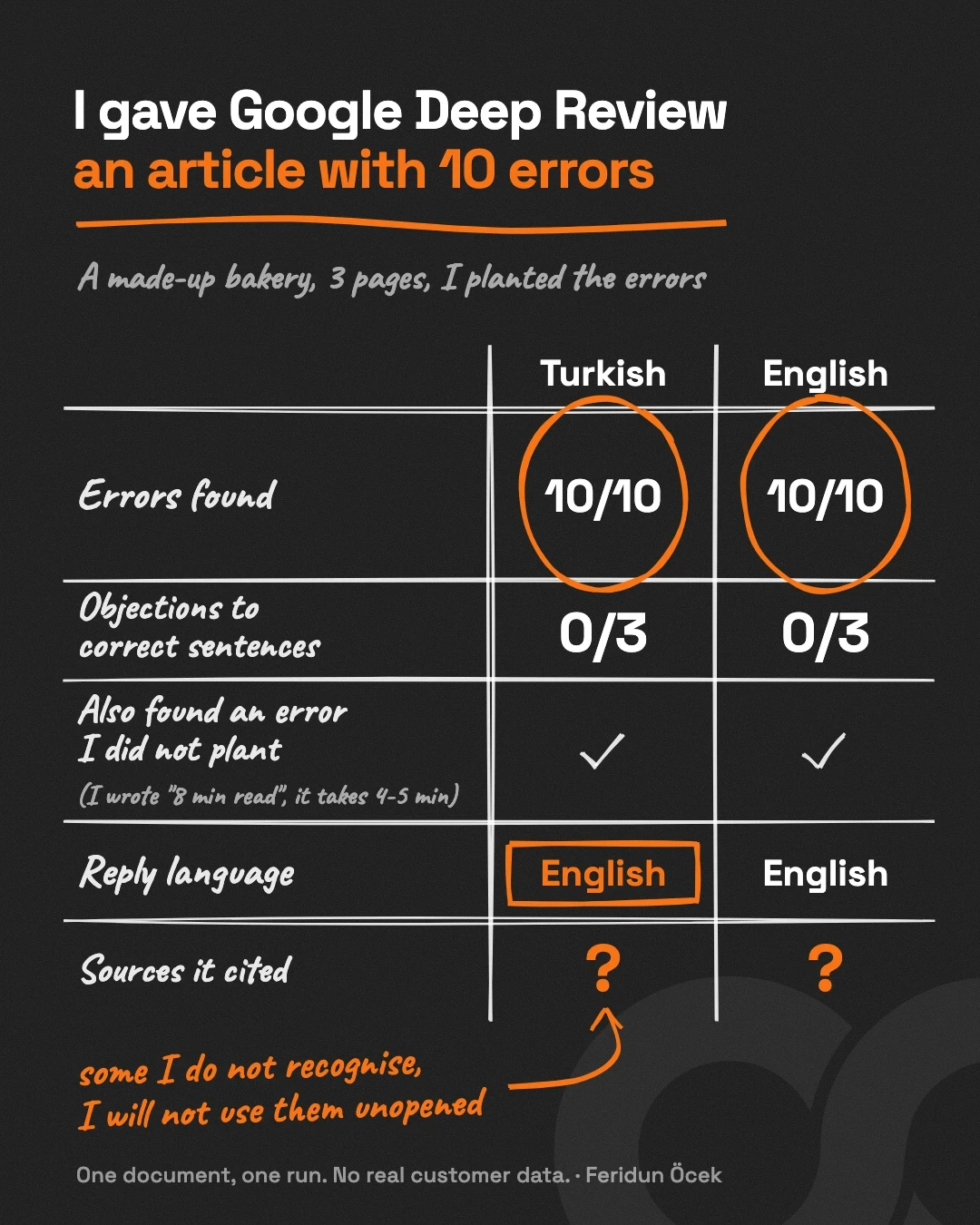
It found all 10 errors
Both runs found all 10 errors; none was missed or got only half a point. The table below shows how each error was written in the English version of the document, what is correct, and what Deep Review said.
| # | Error type | In the document | Correct | Deep Review |
|---|---|---|---|---|
| 1 | Calculation | Weekly total in the table: 540 minutes (9 hours) | 420 minutes (7 hours) | Found; said the 9 hours inflate the money calculations that follow by 28.6% |
| 2 | Calculation | Per year: 10,800 × 12 = TRY 108,000 | TRY 129,600 | Found; said the written figure is the result of ×10 |
| 3 | Calculation | TRY 1,200 monthly subscription, “about 25% of the monthly gain” | About 11%; about 14% with the correct hours | Found; calculated both ratios |
| 4 | Date | Plan table 2 + 2 + 1 weeks, text says “6-week trial in total” | 5 weeks | Found |
| 5 | Date | A trial starting on 4 January 2027 ends on 26 February 2027 | 26 February is the end of week 8; for 5 weeks, 5 February | Found; gave the end dates for a 5- and a 6-week plan |
| 6 | Contradiction | “Never send a reply written by AI to a customer without reading it” and “Set replies to common questions to send automatically” | The two pieces of advice contradict each other | Found |
| 7 | Contradiction | “Everything in this guide can be done with free versions” and “needs a TRY 1,200 monthly subscription” | The two statements contradict each other | Found |
| 8 | Unsourced claim | “Research shows that small businesses using AI grow their revenue by 35% in the first year” | No source, sample or country | Found |
| 9 | Unsourced claim | “Customer replies written by AI bring in more sales than replies written by people” | No basis | Found; also flagged the “they welcome it” sentence next to it |
| 10 | Missing legal context | Upload your customer list (name, phone number, recent orders) and have it write personal campaign messages | Personal data and permission for commercial messages are never mentioned | Found; listed KVKK (Turkey’s data protection law), transfer of data abroad, explicit consent and permission for commercial messages (İYS, Turkey’s register for commercial messages) |
The first three errors were linked. The wrong total in the table (9 hours) had been carried over unchanged into the calculation box; the money calculations in the box were correct in themselves but used the wrong hours. Deep Review caught this chain separately in both runs: first it said the total should be 7 hours, then that the multiplication in the yearly line was wrong, and finally that the subscription ratio did not come to 25% in either calculation.
The most useful finding for me was error 10. The paragraph in the document suggested uploading the customer list to an AI tool but said nothing about personal data. The tool did not settle for a one-line warning: it listed KVKK, the transfer of data to a service abroad, information and explicit consent, and permission for commercial messages with the İleti Yönetim Sistemi (İYS) one by one, and suggested using a template with placeholders instead of the list. This is not legal advice, but it asks the questions a business owner might overlook in the right place.
I am publishing both Deep Review reports unedited: the report on the Turkish document and the report on the English document. Both reports are in English. I did not change the text; a box on the first page flags the sources I did not check and the references that look suspicious.
Did it object to the correct sentences?
I had put three sentences in the document that are correct but invite a check at first glance:
- “ChatGPT was opened to the public in November 2022. In the roughly 4 years since…” ChatGPT launched on 30 November 2022, and the document is dated 20 November 2026.
- “Saving 15 minutes a day adds up to 90 minutes, or 1.5 hours, over a 6-day working week.”
- “Time spent on messages dropped from 60 to 40 minutes a day, a reduction of one third.”
The English run explicitly marked all three sentences as “verified”. The Turkish run did not object to any of them, but did not say they were correct either. There was no clear false alarm. The English run had one borderline note: it pointed to Article 50 of the EU AI Act on transparency. Whether this article applies when a person reads the reply and sends it is debatable; I did not count it as a false alarm.
The error I did not plant: reading time
At the top of the test article I had written “Reading time: 8 minutes”. I had not planted this as an error; it was simply left over from writing the article. In both runs Deep Review said this time was too long.
I counted myself: the Turkish text has 887 words; at a reading speed of 180 to 200 words a minute that is about 4.5-5 minutes. The English text has 1,093 words, also 4.5-5 minutes. The finding was correct. Only the tool’s own word estimate came out low: it said 750-800 words for Turkish and about 930 for English. The finding was correct, but I still had to count the figure behind it myself.
In both runs other real findings came in that were not in the answer key:
- Calculating the month with 4 weeks and the year with 12 months counts a year as 48 weeks; a year has 52.
- The article never compares with the free quick replies feature of WhatsApp Business.
- Sending common replies automatically needs a connection to WhatsApp or Instagram; this contradicts the “no other fees” sentence.
- The article says “do not change everything at once”, yet the example business changed four tasks at the same time.
- The trial plan has no “track your time in the first week” step, even though that is the first step of the article’s own guide.
Two weak spots: reply language and sources
It answered the Turkish document in English
The review of the Turkish document came in English. The summary and headings were in English, the section names were in Turkish and English side by side, and the quotes from the document were in Turkish. The findings were correct, but for a business owner who does not read English the tool is hard to use like this.
I did not verify the sources it cited
Deep Review also cites sources to support its findings. I did not open and check them one by one, so I do not praise it for “finding sources too”. Some look like known publications, for example the US standards institute NIST’s AI 600-1 document and the EU AI Act. Others have strange references: a “Gartner Research / IAB 2025” citation that merges two separate organisations into one reference, double-year dates such as “2023/2026”, and a paper title I have never seen. These may be made up, or real publications cited wrongly. I would not use any of them in my own document without opening and reading them.
Where should a small business use Deep Review?
Where I would use it
- Quotes and price lists before sending: calculation and date mismatches between the table and the text
- A post for your website: unsourced claims, contradicting advice
- Presentations and reports: whether the bullet points match the numbers
- A reminder of forgotten legal questions: personal data, permission for commercial messages
Where I would not use it
- A document with customer names, phone numbers or amounts, before it is cleaned
- Finding sources: citations should not be used before they are opened and read
- Instead of legal advice: the data protection warning is a reminder, not a lawyer’s assessment
- Work that needs the review in the document’s own language: for my Turkish document it came in English
The order I would follow before giving a document to Deep Review:
Remove confidential information
Replace customer names, phone numbers and amounts with placeholders such as [Customer] and [Amount].
Save as PDF or plain text
According to Google, these two formats are accepted for now.
Find each finding in the document
Compare every comment with the line it refers to; skip the ones that do not hold.
Redo the calculations yourself
Even when the tool points to the right place, check the figure it uses.
Open the sources
Do not put a citation in your document that you have not opened and read.
The limits of this test
- One document. A 3-page blog post of 887 words (1,093 in English). I did not test a long contract or a technical document.
- One run per language. I do not know whether uploading the same document again would give the same result.
- I planted the errors. Errors planted on purpose may be more obvious than errors in real documents.
- I did not measure the review time. So I say nothing about how long it takes.
- Free version. I did not test the version that runs with an API key.
So I do not say “Deep Review works well in Turkish”; it worked well on this document. A general verdict for Turkish needs more tests with documents of different kinds and lengths.
Frequently asked
What is Google Deep Review?
A document review tool from Google Research. It returns a review that marks calculation errors, gaps in reasoning, unsupported claims and missing context in the document you upload. It opened to everyone on 14 October 2026; it was built for research papers, and Google also lists presentations and legal and financial documents as uses.
Is Deep Review free?
Every user gets 2 free reviews a week. For more, you need to connect your own Gemini API key.
Does Deep Review work with documents in Turkish?
In my test it found all 10 errors in a Turkish article with 10 planted errors and did not object to the 3 correct sentences. But it gave its review in English. With one document and one run, it is too early to say it works well in Turkish in general.
Does Google store the document I upload?
According to Google’s announcement, uploaded documents are stored for 1 year only to show them in the interface and are never used to train, fine-tune or improve its models. Still, I recommend removing customer names, phone numbers and amounts from a document before uploading it.
Can I trust the sources Deep Review cites?
Not without opening and reading them. In my test some of the cited sources looked like known publications, while others had doubtful references: citations that merged two organisations into one reference or carried two years.
Sources
A short version of this post is on LinkedIn. Read it on LinkedIn
← All posts