AI
Five questions for an AI before Black Friday: is this deal real?
Before Black Friday I had an AI check a test wishlist of three items. The slowest part had nothing to do with the AI. It was writing down what I actually needed to know.
In this post
Every year, as Black Friday gets close, the same question comes up: is this discount real, or was the price raised first so it could be cut? This year I asked an AI, and I shared the result briefly on LinkedIn. This article covers the whole test: which questions I wrote and why, what came out for three products, and the part I think matters most, what this small test says about the way we work.
The slowest part: writing down my questions
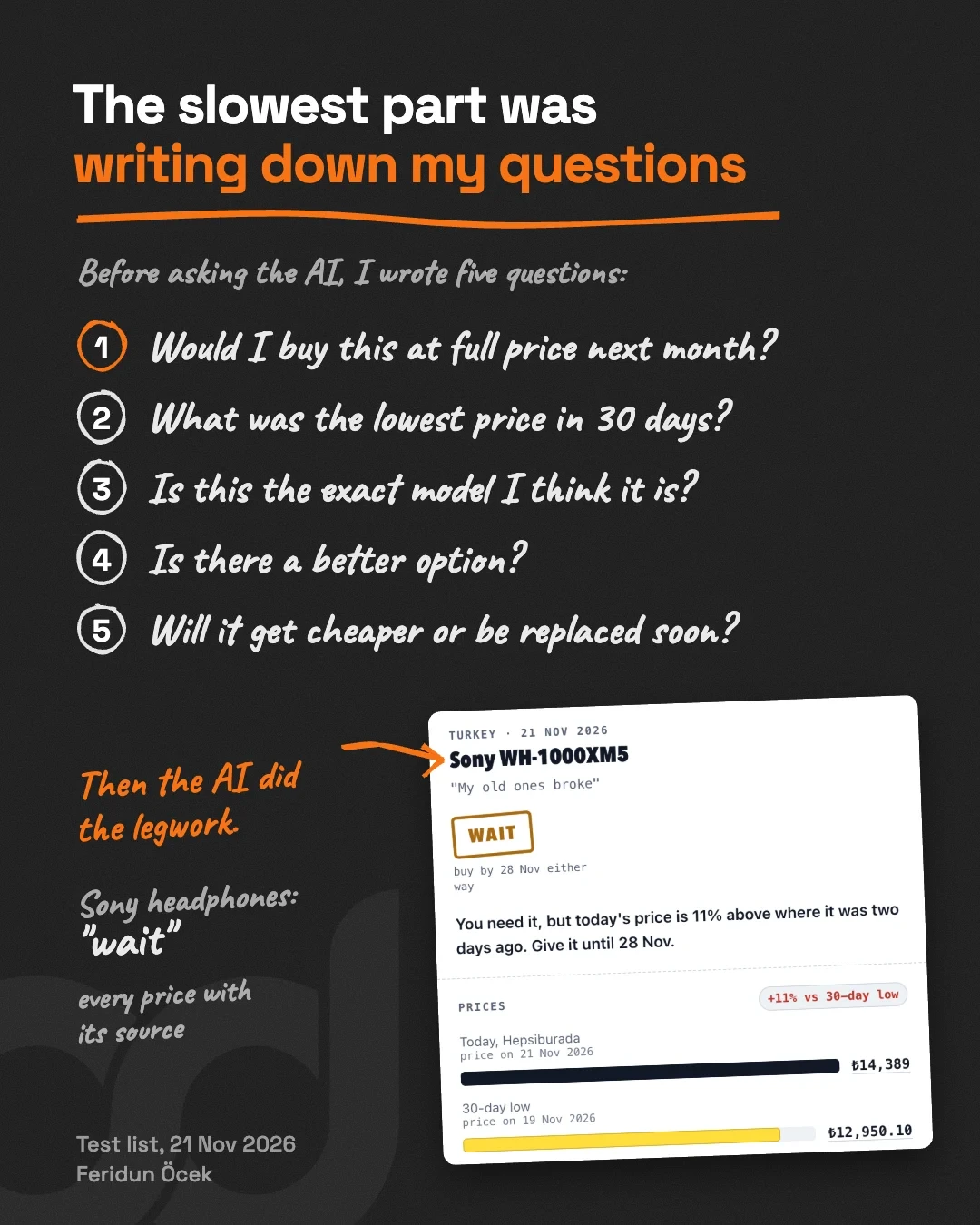
“Find me a cheap one” is easy to ask. But I did not need something cheap. I wanted to know two things: is this discount real, and should I buy this at all? I split that into five questions an AI can answer:
Would I buy this at full price next month?
If not, I want the discount, not the product.
What was the lowest price in the last 30 days?
To compare today’s price with the recent past, not with the seller’s struck-through price.
Is this the exact model I think it is?
So an older or cheaper model with a similar name does not pass as a deal.
Is there a better option?
Previous model, refurbished, or abroad with all costs included.
Will it get cheaper or be replaced soon?
If a new model is on its way, today’s discount means something else.
Once the questions were clear, the AI did the legwork. Every price came with its source and the date it was seen; where it found nothing, it said “not found” instead of guessing. That second part matters as much as the first: deciding on a price without a source is not much better than not checking at all.
What came out of the 21 November run?
None of the three came back as “buy”. That does not mean the tool says no to everything; on that day those prices simply were not deals.
| Product | Country | Best price found | 30-day low | Verdict | Why |
|---|---|---|---|---|---|
| Sony WH-1000XM5 headphones | Turkey | 14,389 TL (Hepsiburada, via Akakçe) | 12,950.10 TL (19 Nov) | Wait | A real need, but 11% above the price two days earlier |
| AirPods Pro 3 | Germany | €199.99 (Amazon.de, via Geizhals) | €187.19 | Skip | A “nice to have”; the price tracker itself calls today’s price “normal price” |
| Dreame D20 Pro Plus robot vacuum | Netherlands | €199 (Coolblue and bol) | €179 (29 Oct) | Wait | €199 has been its everyday price since September, and the must-have features are not decided yet |
Two of the three were not deals at all. The robot vacuum has cost €199 since September and was €179 a month ago. For the AirPods Pro 3 at €199.99 on Amazon.de, Geizhals labels the price “normal price”; it is the six-month median. And since they were only a “nice to have”, the first question already pointed to skip.
The run also showed why the third question is on the list. On a Turkish price site, a product titled “same processor as WH-1000XM5” was listed at 11,800 TL. It looks like a discounted XM5, but it is a different, cheaper model: the Sony ULT Wear. Without the model-number question, that “deal” could have made it onto the list.
No app, no server
Deal Check is not an app. It is an open source set of instructions for the ChatGPT, Gemini or Claude you already use. You write one line to your own AI, and it builds your own price page inside the chat. A few days later, ask it to “check prices again” and the new prices appear next to the old ones, so you also see where the price is going.
A few years ago
- Having an app or browser extension built for price tracking
- Code that scrapes prices from shop websites, and keeping it working
- Going back to a developer to change one question
- Putting the results together in your head
Today
- Five well-defined questions
- An AI chat you already use
- Changing one sentence to change a question
- A decision page with the source next to every price
What really changes: how we look at the problem
The lesson I took from this test is not about discounts. The way we work changes once the way we look at a problem changes; the tool comes second. Instead of “which software should we get for this?”, ask “what exactly am I deciding here?”
The same question works well beyond shopping. A few examples:
- Choosing a supplier quote: what am I comparing besides price? Delivery time, payment terms, warranty, the difference to last year’s quote.
- Renewing a software licence: if I were buying this for the first time today, would I still buy it? How many people actually use it?
- Judging an advertising offer: which number will tell me whether this spend worked?
Once the questions are written down, an AI can take over the tiring part of the research. Without them, even the best tool does not get much further than “find me something cheap”.
Limits of this test
- A test list. Three products, one day, one run. Not my own shopping.
- Prices from 21 November 2026. They change daily; the numbers here are not today’s deals.
- It could not reach everything. The Turkish sellers’ own pages, for example, did not open, so their “was” prices could not be checked. It said so in the result.
- The decision is yours. Check the price history yourself before you pay: Geizhals or idealo in Germany, Tweakers in the Netherlands, Akakçe in Turkey.
To try it, write this one line to your own AI: “Set up Deal Check for me: https://github.com/feridunocek/deal-check-tool”. The tool’s page is here, and the full 21 November run with a source for every price is in the example file on GitHub.
Frequently asked
What is Deal Check?
An open source (MIT) set of instructions that checks with five questions whether a discount on days like Black Friday is real. It is not a separate app; it runs inside an AI you already use, such as ChatGPT, Gemini or Claude.
Does Deal Check cost anything?
Deal Check itself is free and open source. The pricing and terms of the AI you use still apply.
What is the 30-day rule for discounts?
In the EU, including Germany and the Netherlands, a price reduction must be shown against the seller’s lowest price in the previous 30 days. A “was” price above that overstates the discount.
Can I trust the prices the AI finds?
By checking the source. Deal Check writes the source and the date seen next to every price and says “not found” where it found nothing. Still, check the price and its history yourself before you pay.
Does this approach work beyond shopping?
I think that is where it matters most. For recurring decisions such as a supplier quote, a software renewal or an advertising spend, writing down “what exactly am I deciding here?” makes more difference than which tool you use.
Sources
A short version of this post is on LinkedIn. Read it on LinkedIn
← All posts